
Nobody thinks about receipt paper until the terminal spits out a blank slip in the middle of a Friday rush. Then suddenly it matters a great deal — and the person sent to the back room discovers that the spare box says bond rolls when the machine at the front wanted thermal, or that the width is off by an eighth of an inch and the roll simply will not sit in the printer.
Bond and thermal rolls look nearly identical on a shelf, but they are not interchangeable. Here is the plain-English difference, plus the widths and lengths you will actually see on a case in Atlantic Canada.
What is a bond roll, and how is it different from a thermal roll?
A bond roll is ordinary paper. No coating, and it needs an ink ribbon or cartridge in the printer to make a mark — the printer physically strikes the paper. Because it is plain paper, bond can be layered: a 2-ply roll gives a white original and a canary copy at once, which is why kitchen printers and older order stations still use it.
A thermal roll has a heat-sensitive coating on one side. The printhead applies heat, the coating darkens, an image appears. No ribbon, no cartridge, nothing to replace but the roll. That is why nearly every modern debit terminal and countertop POS printer runs thermal.
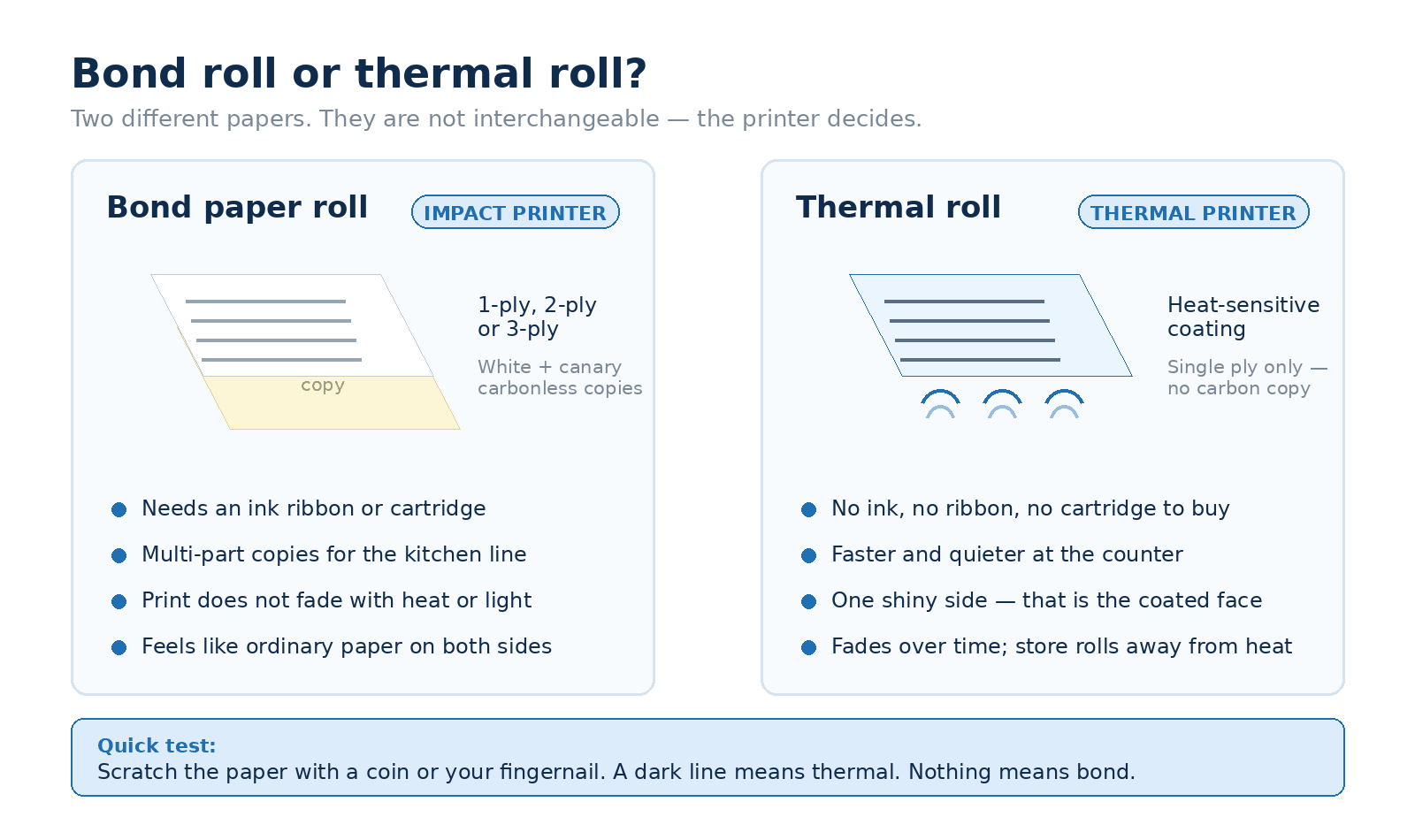
If you have an unlabelled roll in the storeroom and want to know which is which, drag a coin or your fingernail firmly across the paper. Thermal leaves a dark grey line. Bond leaves nothing.
Receipt roll widths: 44 mm, 57 mm, 76 mm and 80 mm
Width is the one measurement that has to be exactly right. Length and diameter affect how often you change the roll; width decides whether the roll fits at all. Four widths cover virtually every machine you will meet behind a counter.
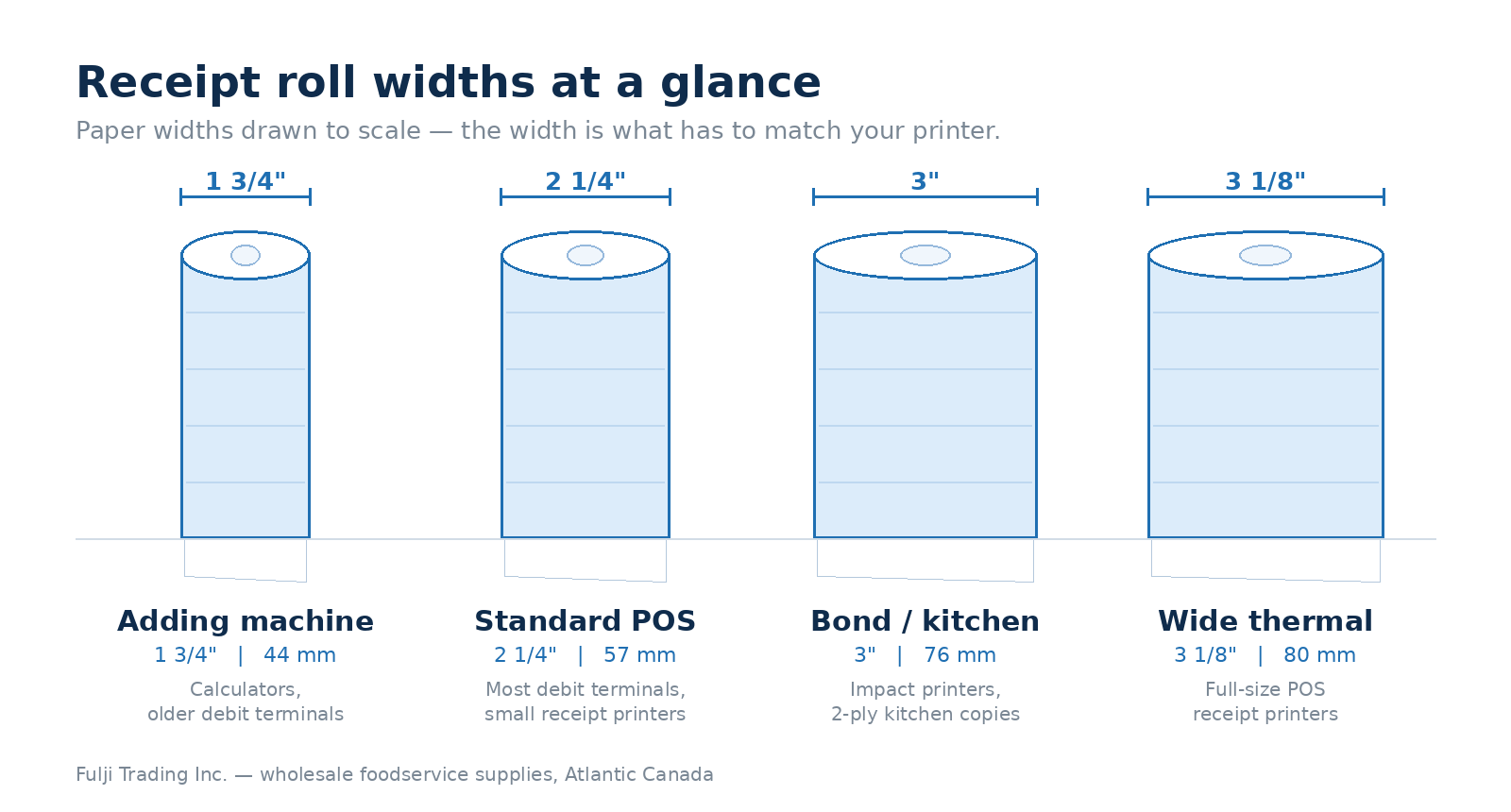
| Width | Metric | Usual paper | Where you see it |
|---|---|---|---|
| 1 3/4" | 44 mm | Bond | Adding machines, calculators, some older debit terminals |
| 2 1/4" | 57 mm | Thermal | The workhorse size — most debit and credit terminals, compact receipt printers |
| 3" | 76 mm | Bond (often 2-ply) | Impact printers, kitchen and bar order copies |
| 3 1/8" | 80 mm | Thermal | Full-size POS receipt printers at the front counter |
Note the trap in the middle: 3" and 3 1/8" are only an eighth of an inch apart, and a 3 1/8" thermal roll will not behave in a 3" impact printer. Different paper, different width, different job.
How do I know which roll my printer takes?
Three checks, in order of speed:
- Look at the old roll. The core or the wrapper almost always carries the size. Keep one empty core in the office as a reference.
- Measure the paper, not the roll. Lay a ruler across the width of the paper itself. Diameter varies with length; width does not.
- Check for a ribbon. Open the printer. If there is an ink ribbon cartridge inside, you need bond. If there is only a rubber roller and a printhead, you need thermal.
Write the answer on a label inside the cupboard door. It saves the next person a phone call.
What the length on the box actually means
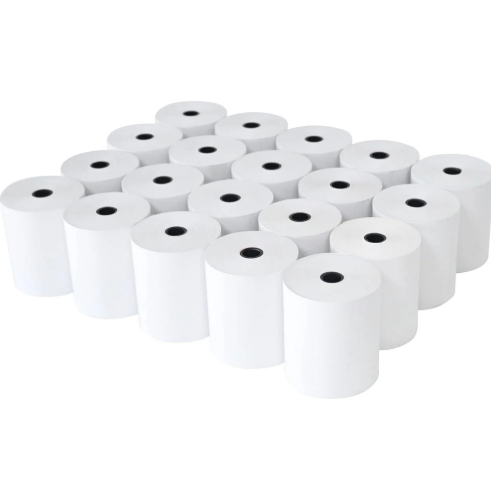
After the width, you will see a length: 45', 50', 60', 185', 230'. That is the total paper on the roll, and it is the number that decides how often somebody has to stop and reload.
The rough math is easy. Multiply the length by 12 to get inches, then divide by the length of one of your receipts. A 3 1/8" x 180' roll is 2,160 inches of paper; if your average receipt runs 6 inches, that is about 360 receipts per roll. A 2 1/4" x 50' debit roll is 600 inches — roughly 100 slips. Run the numbers on a real receipt from your own till, because a pizzeria printing a six-item order uses paper very differently than a coffee counter printing two lines.
Longer rolls cost more each but less per receipt, and they cut down on reloading. The limit is your printer: some compact terminals will not close over a large-diameter roll, so check the maximum diameter before switching to a 185' or 230' roll.
1-ply, 2-ply or 3-ply: when multi-part bond rolls earn their keep
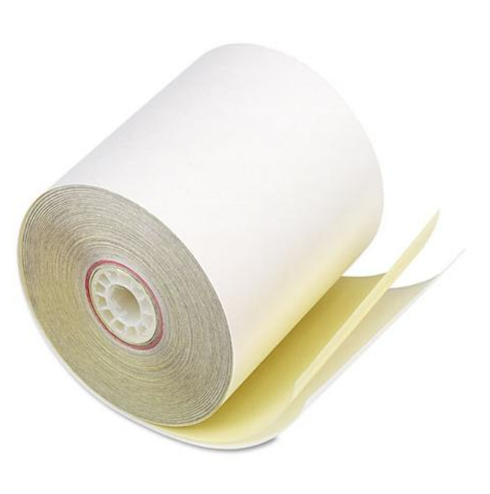
Ply only applies to bond. One ply, one copy. A 2-ply roll prints a white original and a canary carbonless copy in a single pass — one for the customer, one for the kitchen or the till. Three-ply adds a third colour for a third destination.
If a paper copy has to go somewhere — a chit to the line, a signed merchant copy filed at close — 2-ply bond does it with no extra step. If everything downstream is already on screens, single-ply thermal is faster, quieter and cheaper to run.
Is thermal paper safe to handle?
Staff ask this more often than owners expect. Thermal coatings have historically used bisphenol A (BPA) or bisphenol S (BPS) as the developer chemical. The European Union restricts BPA in thermal paper; Canada has no such ban. Health Canada has said it has not concluded that BPA in thermal receipt paper is a significant source of exposure for the general population, and that it has no plans to ban BPA or BPS on receipts.
Some Canadian retailers moved to bisphenol-free stock anyway, and phenol-free rolls are available if your team handles hundreds of receipts a shift. Sensible practice either way: wash hands before eating, and keep till duty and food handling separate where you can. If it matters to your business, ask specifically for BPA-free or phenol-free thermal and get it in writing on the spec sheet.
How many rolls should you keep on hand?
Receipt rolls are cheap to store and expensive to run out of, so be generous with the par level. Count your terminals, work out rolls per week from the math above, and hold two to four weeks of cover. A case of 50 sounds like a lot until you realise a busy pizzeria with three stations can go through one in a month.
The same logic applies here as to cups and containers — our guide to calculating par levels for disposables walks through the full method with worked examples.
Buying bond rolls and thermal rolls in Atlantic Canada
Receipt rolls are light, low-value and dull, which makes them exactly the item that falls off the order sheet and then gets bought at retail prices in a panic. Buying by the case avoids that, at a fraction of the cost of a same-day run to an office supply store.
Fulji Trading stocks bond rolls and thermal rolls by the case in the common 2 1/4", 3" and 3 1/8" widths, alongside the rest of the counter and takeout supplies that restaurants, pizzerias and cafés go through every week. If you would rather pick up than wait on a delivery, our cash-and-carry warehouse in Moncton at 61 Halifax Street is open to the trade, and we deliver across New Brunswick, Nova Scotia, PEI and Newfoundland.
Bring the empty core with you. It is the fastest way to get the right roll on the first try.