
Cooking oil is one of the few line items where a bad buying decision shows up twice: once on the invoice, and again in the taste of the food. Buying bulk cooking oil well comes down to three things — picking the container size that suits your kitchen, matching the oil to the job, and knowing how fast you actually go through it.
Here is the practical version for owners and operators, from a wholesaler that fields these questions across the counter most weeks in Moncton.
What sizes does bulk cooking oil come in?
Foodservice oil in Canada is sold in a fairly small set of standard formats. Once you can picture them side by side, ordering gets a lot easier.
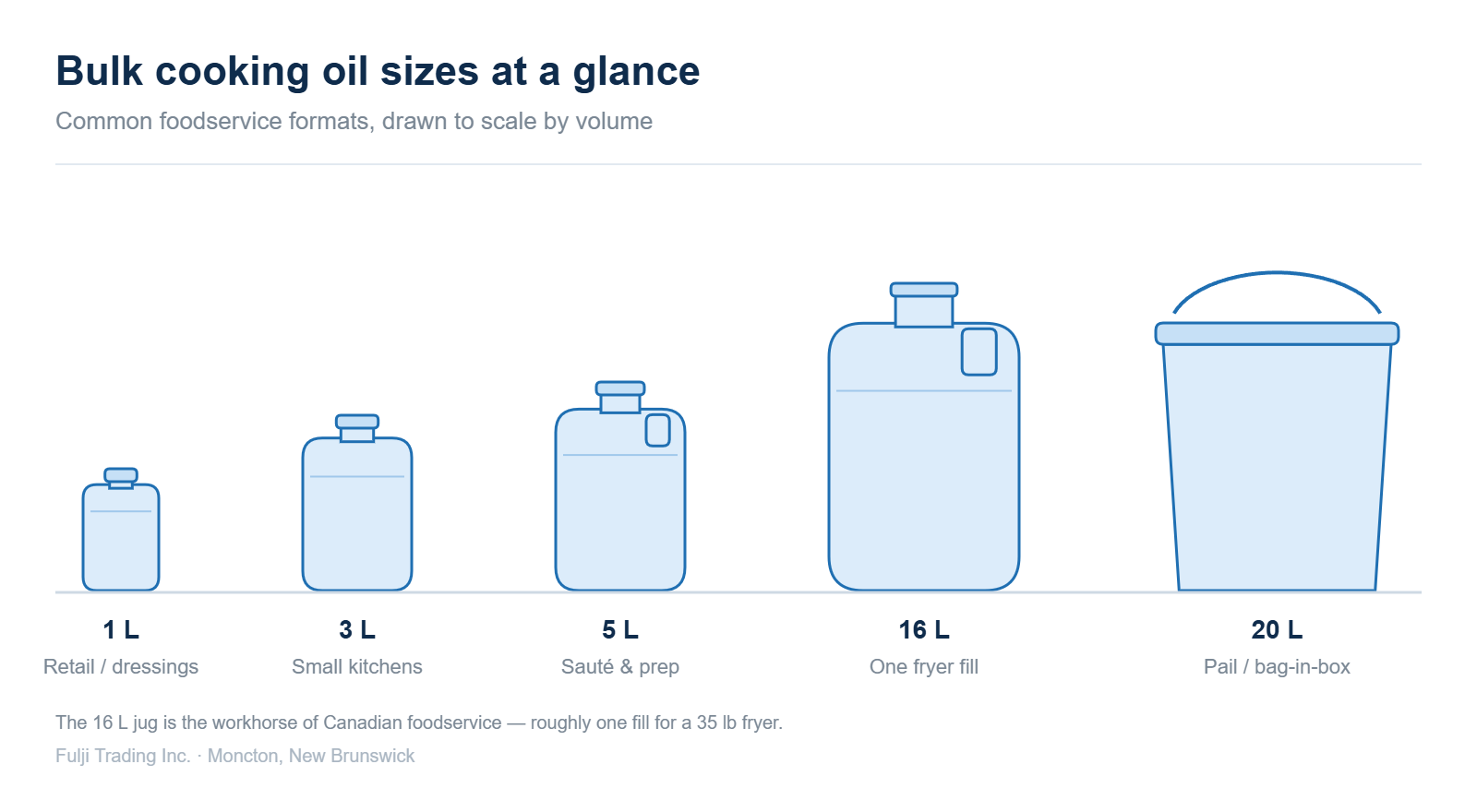
- 1 L bottle — retail size. Fine for dressings and front-of-house, expensive per litre for anything else.
- 3 L jug — a small café or a pizzeria with no fryer.
- 5 L jug — the everyday sauté and prep size. Light enough to pour one-handed, small enough to keep on the line.
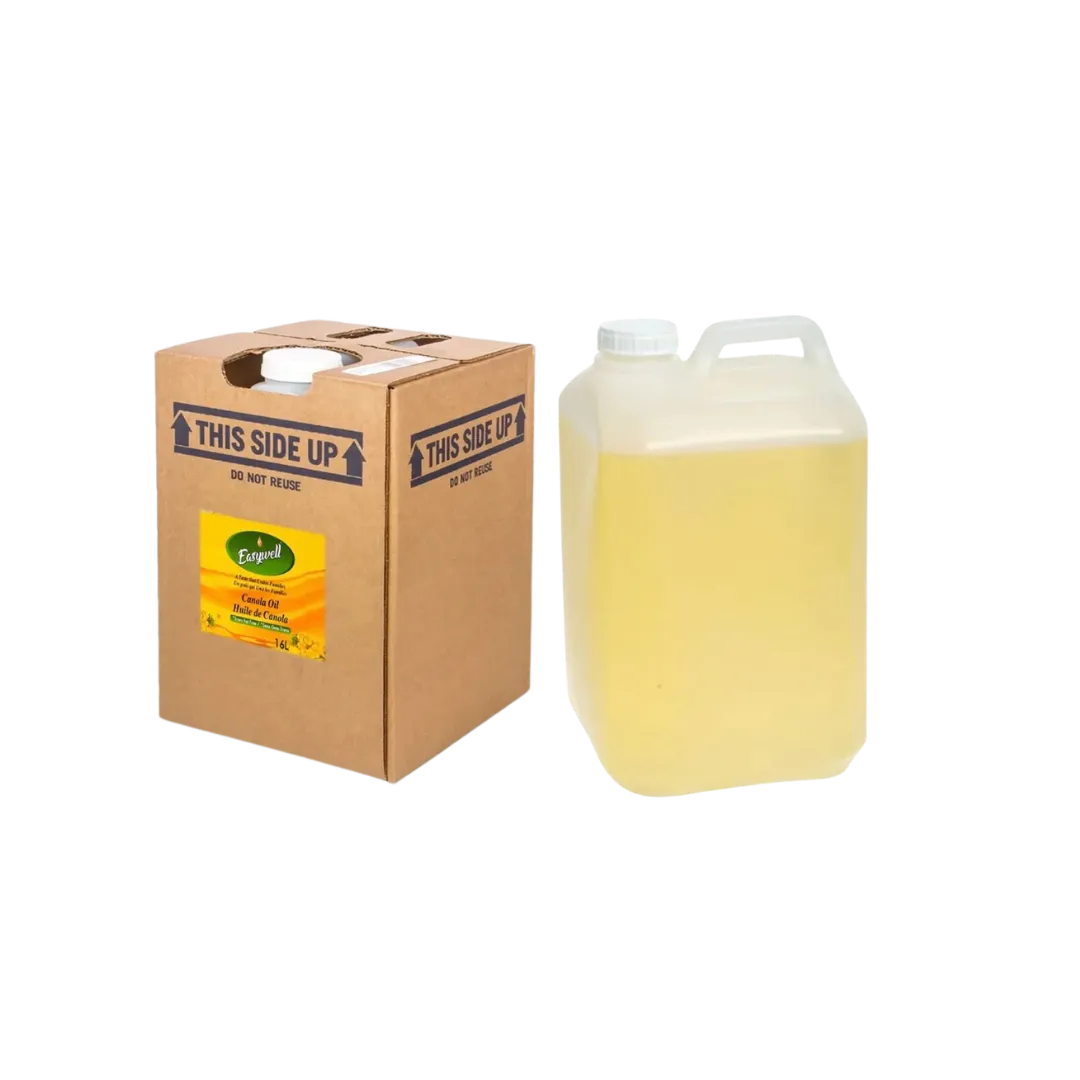
- 16 L jug — the workhorse. This is what most Canadian kitchens with a fryer buy, and it is roughly one fill for a standard 35 lb vat.
- 20 L pail or bag-in-box — highest volume. Bag-in-box cartons have a tap, so you draw off what you need instead of wrestling a full pail.
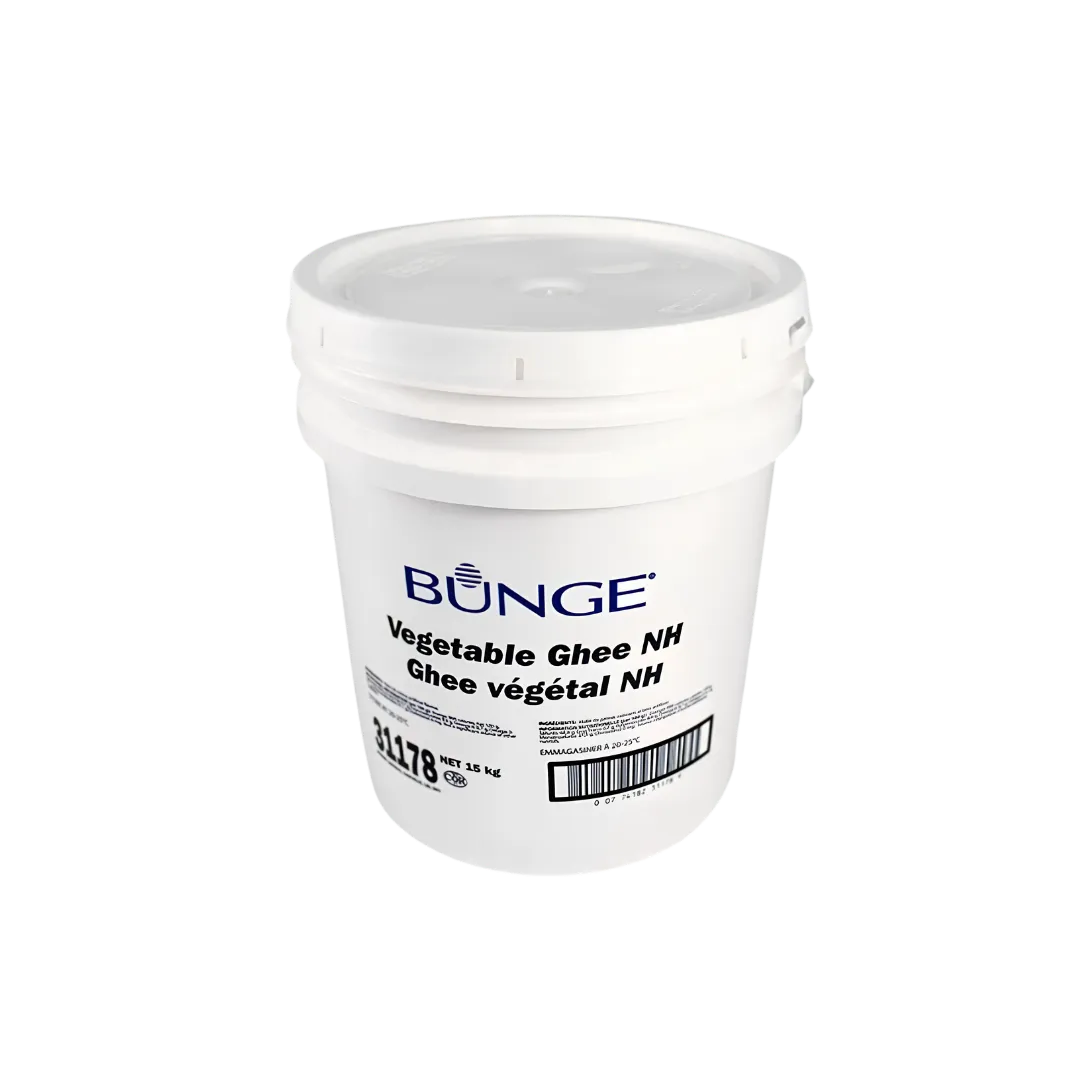
- 15 kg pail (vegetable ghee or shortening) — semi-solid fats are sold by weight rather than volume.
| Format | Best for | Handling | Rough guide |
|---|---|---|---|
| 1 L bottle | Dressings, table use | One hand, no decanting | Highest cost per litre |
| 3 L jug | Cafés, low-heat cooking | Easy to pour | Under a week in most kitchens |
| 5 L jug | Sauté, flat-top, prep | Handle moulded in | Fits under the line |
| 16 L jug | Deep frying | Two hands or a jug pump | About one 35 lb fryer fill |
| 20 L pail / bag-in-box | High-volume frying | Tap on the box version | Best cost per litre |
| 15 kg pail (ghee) | Baking, curries, tandoor | Scoop, not pour | Sold by weight |
How much cooking oil does a restaurant use in a week?
Start with your fryer, because that is where most of it goes. Cooking oil weighs roughly 0.92 kg per litre, so the pound rating on a fryer converts easily:
- A 35 lb vat holds about 17 L
- A 40 lb vat holds about 20 L
- A 50 lb vat holds about 25 L
Now do the arithmetic for your own shop. One 35 lb vat changed twice a week is roughly 34 L of fresh oil before you count daily top-ups — a little over two 16 L jugs. Two vats and you are into a pail a week. Add whatever the wok, the flat-top and the prep station burn through and you have a weekly number you can order against.
How often you change the oil depends on what you are frying. Battered fish, breaded chicken and anything sugary load the vat with fines and shorten its life; plain fries are much gentler. Filter daily, skim between rushes, and the same oil will carry you further. If you already build order sheets this way for packaging, the same approach used in our guide to calculating par levels for disposables works just as well for oil.
Canola, peanut or vegetable ghee: which oil for which job?
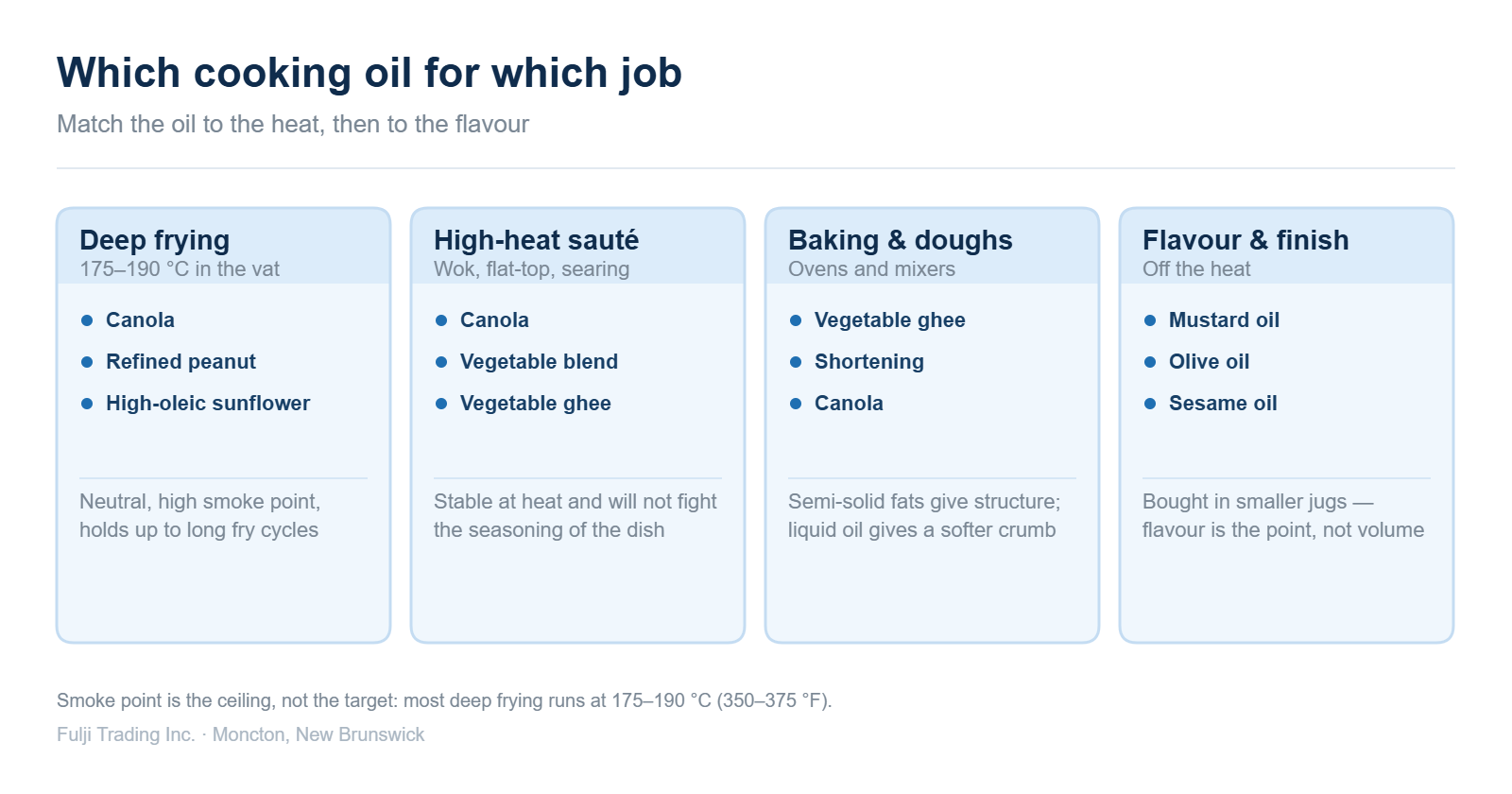
Smoke point gets quoted a lot, and it matters — but it is a ceiling, not a target. Most deep frying runs at 175–190 °C (350–375 °F), which is comfortably below the smoke point of every refined frying oil on this list. What separates them in practice is flavour, stability over long fry cycles, allergen risk and price.
| Oil | Approx. smoke point | Flavour | Best for |
|---|---|---|---|
| Canola (refined) | Around 240 °C / 465 °F | Neutral | All-purpose frying and sauté |
| Peanut (refined) | Around 230 °C / 450 °F | Very mild | Frying — but declare the allergen |
| Vegetable / soybean blend | Around 235 °C / 455 °F | Neutral | Volume frying on a budget |
| Vegetable ghee | Varies by blend | Rich, buttery | Baking, curries, tandoor |
| Mustard oil | Around 250 °C / 480 °F | Sharp, pungent | South Asian cooking, pickles |
| Extra virgin olive | Around 190 °C / 375 °F | Fruity, peppery | Finishing and dressings only |
A note on peanut oil: it fries beautifully, but if you use it, it belongs on your allergen sheet and your staff need to know. Plenty of kitchens choose canola purely to keep that conversation simple.
What Canada's trans fat ban means for your fryer
Since 17 September 2018, partially hydrogenated oils (PHOs) have been prohibited in food sold in Canada — and that includes food prepared in foodservice establishments, not just packaged goods. The old-style hydrogenated frying shortenings are gone.
In practice this is settled ground: your supplier is selling high-stability liquid oils and non-hydrogenated blends already. It is still worth checking the spec sheet on anything imported or unfamiliar, and looking for the words non-hydrogenated before it goes near the vat.
Storing bulk cooking oil so it does not turn
Oil goes off for four reasons: heat, light, air and contact with certain metals. Unopened jugs in a cool, dark dry-goods area will hold for months; the same jug parked beside the fryer will not.
- Store sealed jugs away from the fryer, the dish pit and any direct sunlight.
- Rotate first in, first out. Write the delivery date on the jug with a marker.
- Do not decant into open containers and leave them out overnight — air is the enemy.
- Keep used oil in a clearly marked container for your renderer, well away from fresh stock.
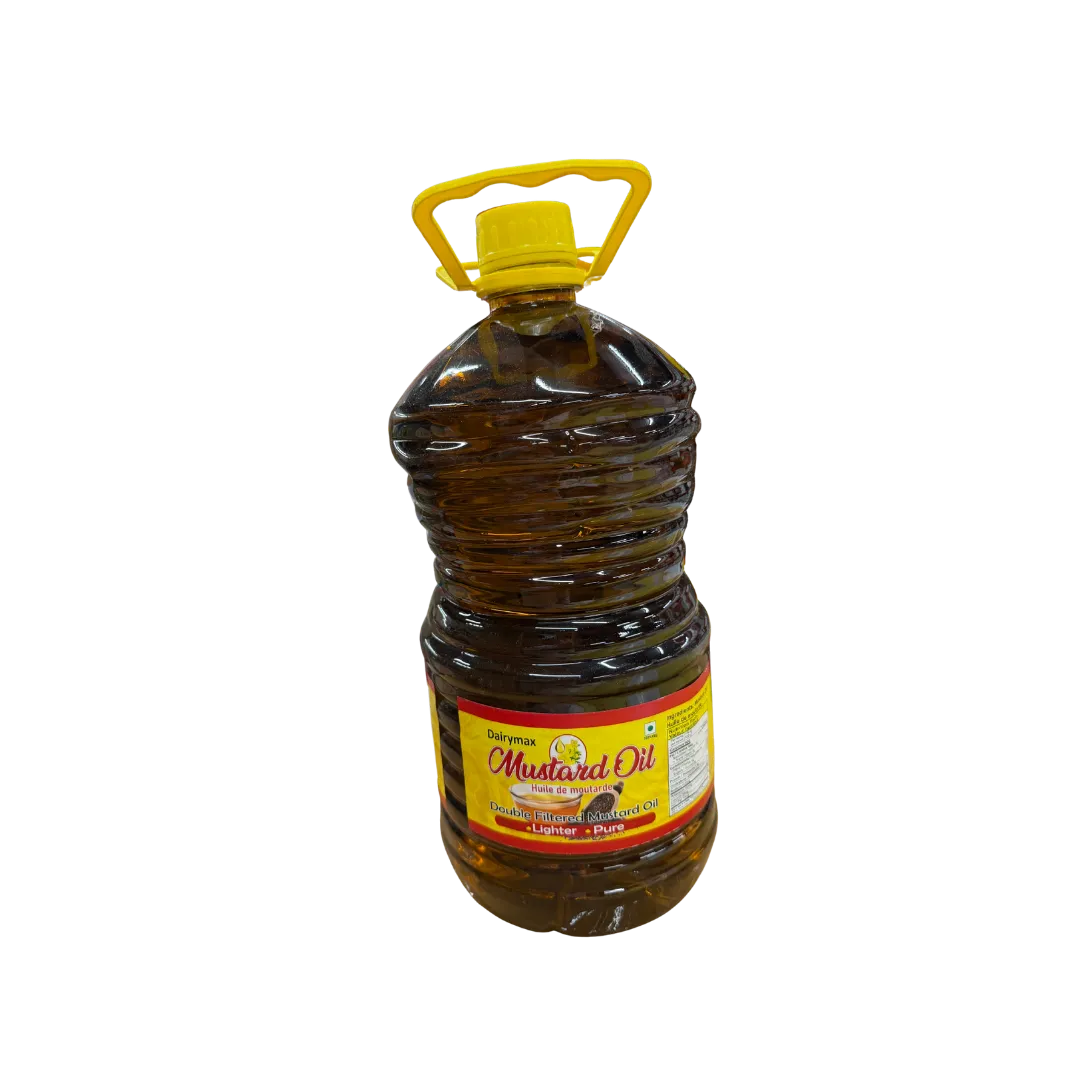
Buying bulk cooking oil in Atlantic Canada
Freight is the quiet cost in cooking oil. It is heavy, it is liquid, and shipping it a long way eats any saving you thought you were making on the case price. Buying regionally usually wins on landed cost, and it means you can pick up a jug the same day when a delivery slips.
Fulji Trading carries bulk cooking oil and ghee alongside the rest of the kitchen list — packaging, disposables, gloves and cleaning supplies — so it goes on one order instead of three. You can browse the full range of wholesale foodservice supplies, or see what we stock for restaurants and catering operations specifically.
If you are nearby, the cash-and-carry counter in Moncton at 61 Halifax Street is open for pickup, and we deliver across New Brunswick, Nova Scotia, PEI and Newfoundland. Not sure which format suits your fryer setup? Tell us how many vats you run and how often you change them, and we will work the numbers out with you.