

Ordering paper cups feels simple until the lids show up and half of them will not snap on. A lid that rocks, leaks, or pops off during a delivery run is a small part that causes a big headache: spilled coffee, an annoyed customer, and a box of lids you cannot use. Here is how cup and lid sizing actually works, so you order the right thing the first time.
The one rule: match the lid to the rim, not the ounces
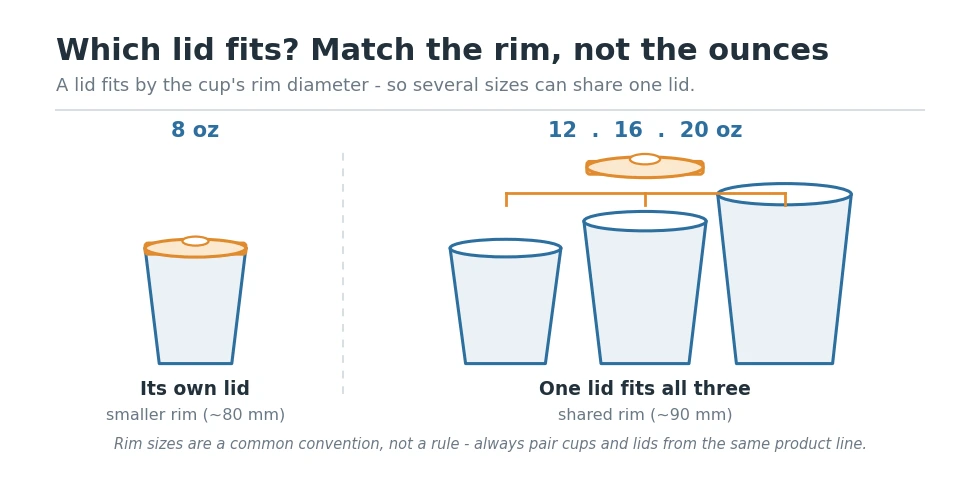
A lid fits based on the diameter and shape of the cup's rim, not the number of ounces printed on the side. Two cups that hold different amounts can take the same lid if their rims are the same, and two cups of the same volume can need different lids if their rims differ even slightly. So when you reorder, the number that matters is the rim (top) diameter, and the safest move is to buy your cups and lids from the same product line, because that is the only way the fit is guaranteed.
Common hot cup sizes and what they are for
Hot paper cups come in a handful of standard sizes. A 4 oz cup suits espresso, samples, and small kids' drinks. The 6 to 8 oz range covers a short coffee, an espresso-based drink, or tea. The 10 and 12 oz cups are the everyday medium coffee or tea. A 16 oz cup handles a large coffee, latte, or hot chocolate, and 20 oz is your extra-large. Most cafes get by with three sizes; adding a fourth mostly adds cost and clutter.
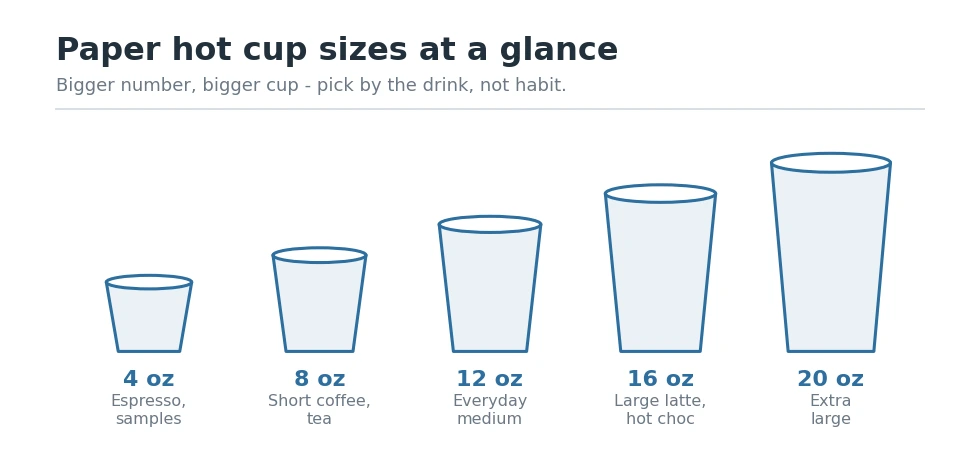
Cup size | Best for | Approx. rim | Lid |
4 oz | Espresso, samples | ~62 mm | Its own |
8 oz | Short coffee, tea | ~80 mm | Its own |
12-20 oz | Medium to extra-large | ~90 mm | One shared lid |
Do 8 oz and 12 oz coffee cups use the same lid?
Usually no. On many supplier lines the 8 oz cup has a smaller rim (commonly around 80 mm), while the 10, 12, 16, and 20 oz cups share a larger rim (commonly around 90 mm). That means one lid often covers your 12, 16, and 20 oz cups, but your 8 oz needs its own lid. It is the reason a cafe that runs small, medium, and large usually stocks two hot-cup lid types, not three.
Those millimetre figures are the common convention, not a rule, and brands differ. Before you assume one lid covers several sizes, check the rim diameter on the spec sheet or test one lid on each cup. Mixing a cup from one supplier with a lid from another is where most fit problems start.
Single wall, double wall, or ripple?
Single wall is the standard, lowest-cost cup, and it is fine for tea, cooler drinks, or when you use a separate sleeve. Double wall and ripple cups add an insulating outer layer so a hot drink is comfortable to hold without a sleeve. They cost more per cup but save you buying sleeves and tend to feel more premium. For a busy takeout counter, moving to a thicker-walled hot cup and dropping sleeves is often close to a wash on cost.
Cold cups are a different system
Cold drink cups (clear PET or PP) are sized and lidded separately from hot cups, so do not expect a hot lid to fit a cold cup. Cold cups take flat lids, with or without a straw slot, or dome lids for whipped and blended drinks. One thing to keep in mind in Canada: single-use plastic straws are restricted under the federal ban, so pair cold cups with paper straws or use strawless sip lids. The paper cups and plastic lids themselves are still allowed; it is foam (polystyrene) cups and plastic straws that the rules target.
The practical takeaway: fewer lid SKUs
The easiest way to cut waste and reorder mistakes is to standardize. Pick two hot sizes that share a lid, say 12 and 16 oz, plus an 8 oz for espresso, and you are down to two hot lids in total. For cold drinks, settle on one or two cup sizes and one lid style. Fewer SKUs means less shelf space, fewer wrong-lid moments, and simpler par levels.
Related reading and where to buy
Fulji Trading stocks paper hot cups, cold cups, and matching lids by the case for restaurants, cafes, caterers, and offices across New Brunswick, Nova Scotia, PEI, and Newfoundland.